
Nitro Directory Books by Collection
No official source inspected lists a stand-alone Nitro publication run. The useful city directory shelf is regional. It combines Charleston and neighboring-suburb books, statewide digital sets, federal guides, and special collections. Search coverage must be checked volume by volume. A catalog title that omits Nitro can still include its streets, while a broad guide may leave the city out.
| Directory source | Date span | Repository | How to use it |
|---|---|---|---|
| Polk's Charleston city directories | 1908 to present claim for Charleston and neighboring suburbs | Kanawha County Public Library | In-library use; ask which years include Nitro |
| Charleston directory shelf | 1874-75 through 2016, with many gaps | West Virginia State Archives | Shelf inventory and staff request; no Nitro-only title listed |
| West Virginia city and business directories | 1839-1929 | William & Mary Libraries | Digitized route; verify title, page image, and location |
| 1930 city-directory guide | 1928 and 1930 Charleston-area listings | National Archives | Regional lead only; Nitro is not named in the guide |
| Reverse books, phone books, and yearbooks | Exact Nitro runs not posted | Nitro Public Library and KCPL | Ask staff for the street, school, and year required |
The State Archives directory inventory names many Charleston years, including runs from 1954 through 2000 and later volumes in 2004, 2007, 2008, 2010, and 2012-16. Those dates describe the shelf, not guaranteed Nitro coverage. KCPL's claim is broader but also requires an in-person check. Record the full title and year before copying any name.
Why Nitro Directories Look Regional
Nitro grew from a World War I industrial center on the Kanawha River. Its residents can surface in Charleston-area books, county material, plant and transport records, or community files even when a cover does not say Nitro. The city also crosses the Kanawha-Putnam county line. That geography makes the printed label less reliable than a street, tax district, or known household name.
The National Archives guide illustrates the issue. It names Dunbar, Kanawha City, St. Albans, and South Charleston within the Charleston directory area, but it does not name Nitro. That omission is not proof that no Nitro entry exists. Check the table of contents, suburb index, alphabetical pages, and street section before ruling out a book.
Early Nitro history also points beyond directory shelves. Industrial, rail, chemical, river, and wartime records may explain a person's presence when the printed city directory misses a year. The city's origin is useful context, but an entry still needs a dated source.
Nitro City Directory Library Route
Begin with the Nitro Public Library at 1700 Park Avenue, 304-755-4432. Ask for a precise street, surname, and year. Then contact the KCPL local-history desk at 304-343-4646 or reference@KanawhaLibrary.org. Three focused questions work well: which Polk volumes include Nitro, whether an address-order or criss-cross section exists, and which local yearbooks or newspapers cover the same date.
The KCPL page below links city directories, newspapers, obituary help, and West Virginia history sources in one place.
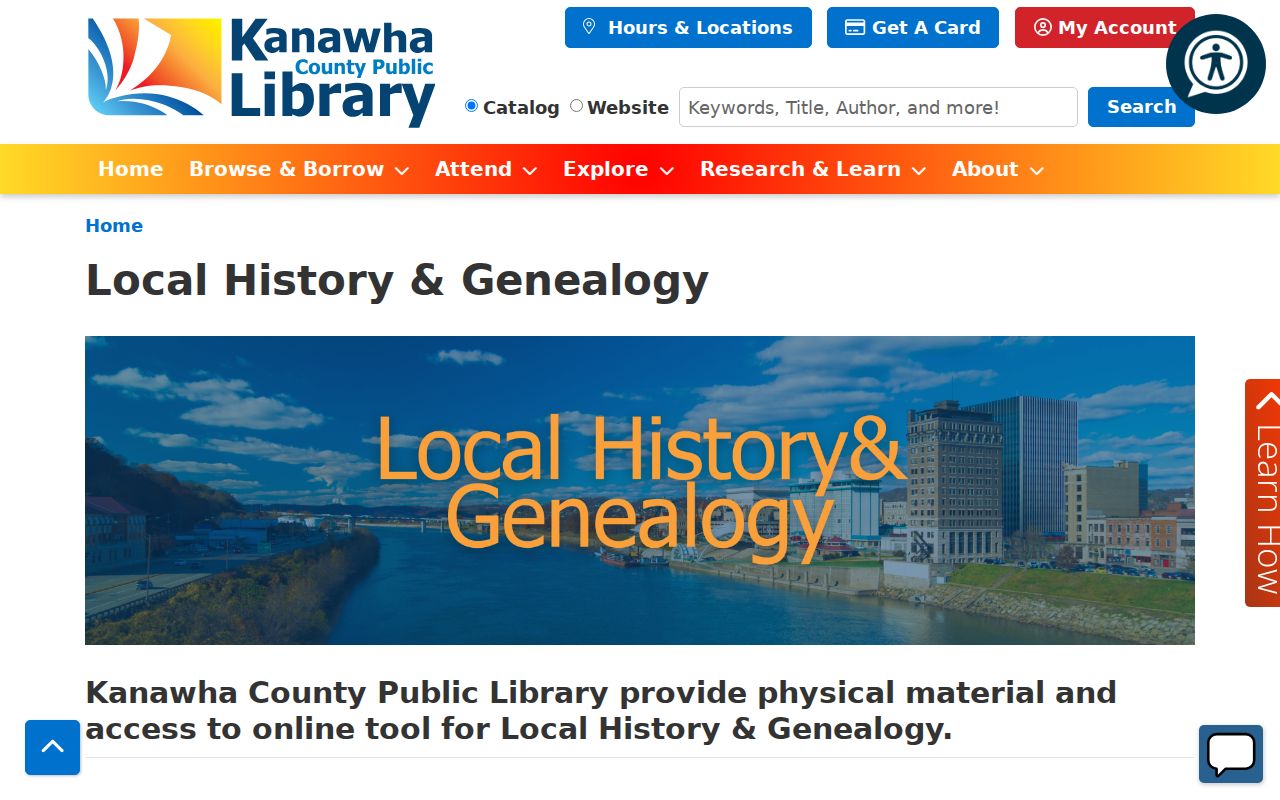
Its mix of sources matters when a directory entry disappears. A newspaper notice or obituary can show death or relocation, while a yearbook can distinguish people who share a name.
Ask for the earliest and latest likely books first. That gives the reference librarian a bounded task and quickly tests whether Nitro appears under its own heading, a suburb section, or only within an address index.
Digitized Nitro Directory Leads
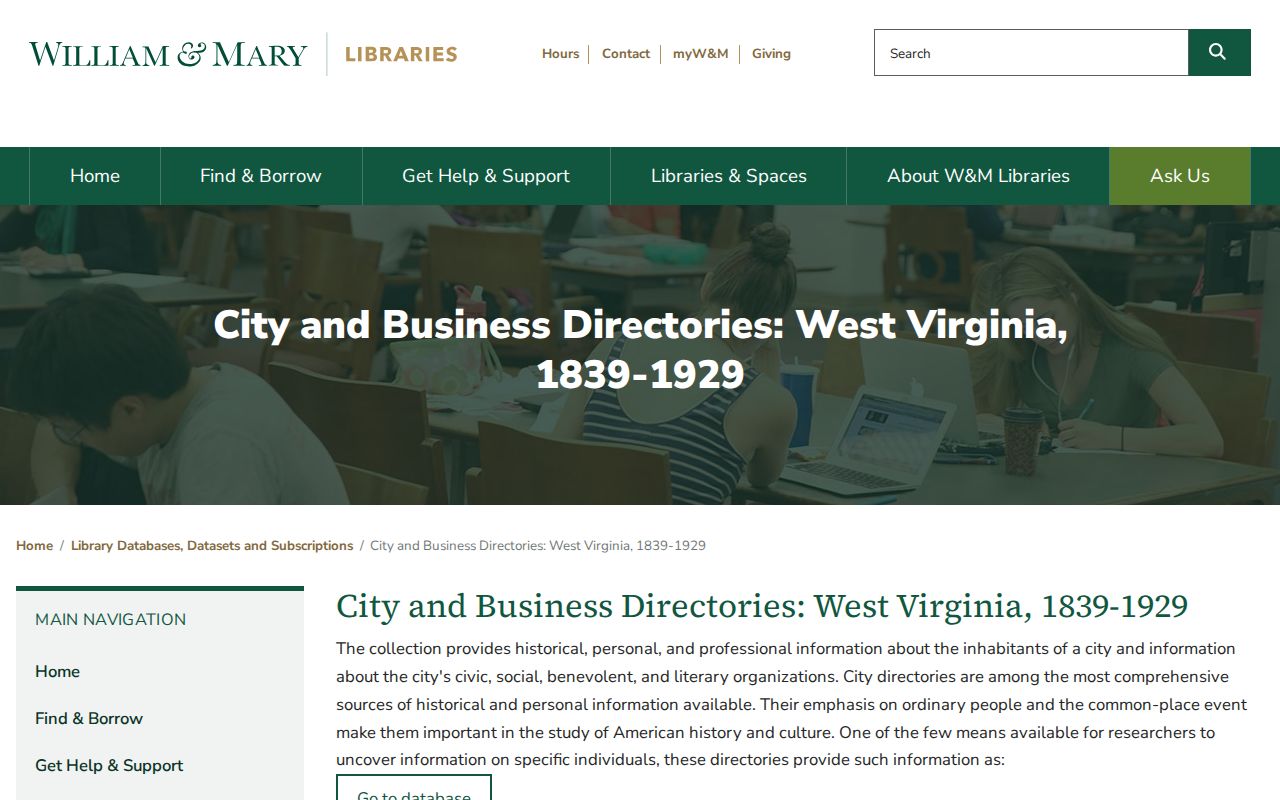
The William & Mary West Virginia directory collection spans 1839-1929. It is the main documented digital route in the research, though the database interface or access terms may control what a visitor can open. Confirm that a scan shows a real page, not only a catalog entry, and verify that the place heading covers Nitro.
The collection landing page shown here identifies the statewide date span and the city-and-business directory focus.
A usable citation should include the collection, book title, publisher if shown, volume year, page number, and image status. Save the location heading with the entry so later readers can see why it was treated as a Nitro match.
Do not merge dates from separate collections. The digital set ends in 1929, the Archives shelf has its own gaps, and KCPL's Polk statement describes a local in-library range. Each claim answers a different access question.
Decode a Nitro Directory Entry
No actual Nitro or Charleston page entry opened during the source inspection. That means no sample person or local abbreviation should be invented. Treat the first accessible page as an evidence-capture job and read the book's own key. Directory layouts commonly contain the fields below, but the marks must be verified in that exact volume.
| Name line | Copy spelling, initials, and name order exactly as printed. |
|---|---|
| Street address | Record the house number, street form, and any cross-reference. |
| Work or business | Capture only what the volume states, with its abbreviation. |
| Household notation | Look for spouse, widow, boarder, or householder marks and verify them against the key. |
| Source details | Save title page, publisher, year, page, and whether the item is a scan or library book. |
- Criss-cross directory
- An address-first section arranged by street and house number rather than surname.
- Householder index
- A listing built around the named person associated with a household entry.
- Abbreviation key
- The volume's own legend for shortened words and symbols. Photograph or cite it before interpreting an entry.
A single line is not enough when Nitro may be filed under a regional heading. Capture the page header and nearby entries. They help establish place, street order, and whether a copied symbol belongs to the name or the column.
Nitro Records Beyond Directory Years
The WVU Historical Records Survey fills gaps with finding aids rather than a resident search box. Reel 82 includes building forms, history, and inventory for Nitro and nearby cities. Reels 87-89 include Kanawha births, marriages, deaths, wills, inventories, record books, and early land records. These sets can connect a directory name to a dated event or parcel.
The West Virginia State Archives also accepts written requests. Staff research is limited to one-half hour and two specific requests. The listed base fee is $10 for an in-state request and $20 for an out-of-state request, with listed county-record copy requests at $5 or $8. Confirm the current service and describe the exact name, county, source series, and date.
These holdings do not turn every Nitro resident into an indexed result. They provide a fallback when a directory year is missing, a person lived outside the publisher's coverage, or the only clue is a will, building form, or land entry.
Note: Archive finding aids show what a reel holds, while a city directory page supplies the dated name-and-address evidence.
Trace Nitro Families Across Directories
A city directory can bridge the years between public census schedules. Federal schedules through 1950 are public under the 72-year rule. Later schedules remain closed until their release dates. Build a worksheet with year, source, name spelling, address, household mark, business or work line, and confidence in the match.
- Find the person in one known Nitro or Charleston-area volume. Save the title page, location heading, year, and entry page.
- Check the name index and street-order section, then inspect adjacent years for spelling changes or a move.
- Compare a public census year. Match age, household relationships, street, and nearby names rather than relying on one surname.
- Test a changed address against the parcel's legal description or the modern Nitro street directory workflow.
- Use an obituary, probate file, or newspaper notice to explain a death, move, or break in the annual sequence.
Disappearance from one book has several causes. The person may have moved, died, used a different name, been omitted, or lived beyond that volume's coverage. Check both county systems when an official record is needed because Nitro spans Kanawha and Putnam counties.
Nitro Directory Addresses on Sanborn Maps
WVU's digitized 1928 Nitro Sanborn object contains ten TIFF files totaling about 1.91 GB. The maps show streets, building footprints, size, shape, materials, use, water mains, hydrants, and other fire-insurance details. They do not list every resident, but they can test whether a directory address was a home, store, industrial site, or vacant lot.
This is especially useful in Nitro because industrial and river history shaped the early city. A building footprint can support an address interpretation, while a later permit or parcel record may show a change in use. Copyright restrictions may apply to post-1923 material, so contact the Regional History Center before republishing an image.
Pair the map with a dated city directory entry. The directory supplies the name; the map supplies the physical setting. Neither alone proves a continuous household.
Reconnect Through Nitro Local Sources
A yearbook, obituary, or newspaper request can help reconnect with a former classmate or identify a relative without treating a current tax owner as the person who lives there. KCPL offers an obituary request form, while Nitro library staff can help identify likely yearbooks, phone books, and local news sources. Exact holdings are not all posted.
Give staff a full name, likely date, Nitro connection, and known street or school. A narrow request is more likely to reach the right shelf or box. If the name is common, include a middle initial, relative, or event year.
Research tip. Ask which exact Nitro street and year a collection covers before requesting a person; regional catalog labels can hide useful local entries.